MacDonell, John. Description of Lake Athabasca and the Chipweans, ca. 1805 and Journal of a Voyage from Lachine to Fort River Qu'Appelle, 1793. An electronic transcription. MFTP #0005
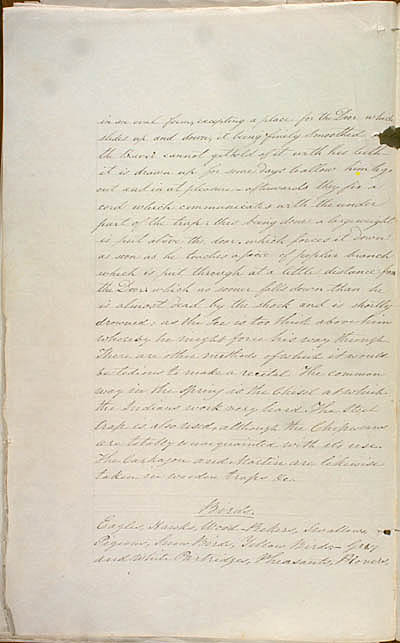
in an oval form, excepting a place for the Door which slides up and down, it being finely Smoothed [that] the Beaver cannot get old of it with his teeth – it is drawn up for some days to allow him to go out and in at pleasure – afterwards they fix a cord which communicates with the under part of the trap; this being done a large weight is put above the door, which forces it down as soon as he touches a piece of poplar branch which is out through at a little distance from the Door: which no sooner falls down than he is almost dead by the shock and is shortly drowned; as the Ice is too thick above him whereby he might force his way through. There are other methods of which it would be tedious to make a recital. The common way in the Spring is the Chisel at which the Indians work very hard. The Steel trap is also used, although the Chipweans are totally unacquainted with its use. The Carkajou and Martin are likewise taken in wooden traps &c.
Birds.
Eagles, Hawks, Wood-Peckers, Swallows, Pigeons, Snow Birds, Yellow Birds;– Grey and white Partridges, Pheasants, Plovers,
[46]
L E G E N D :
in red , modifications made by the editor(s).
in lavender , modifications made by the assumed author(s).