MacDonell, John. Description of Lake Athabasca and the Chipweans, ca. 1805 and Journal of a Voyage from Lachine to Fort River Qu'Appelle, 1793. An electronic transcription. MFTP #0005
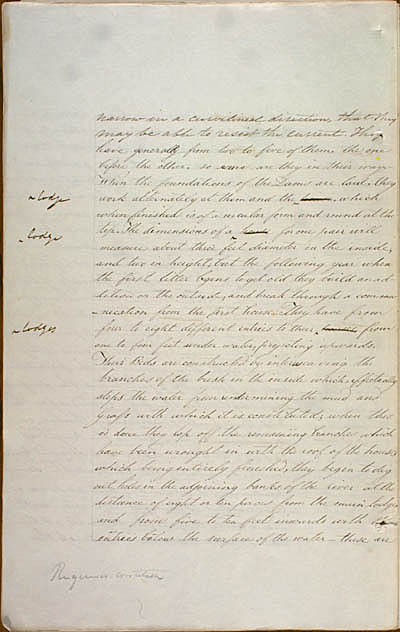
narrow in a curvilineal direction, that they may be able to resist the current. They have generally from two to five of them, the one before the other, so secure are they in their way. When the foundations of the Dams are laid, they work alternately at them and the house, which when finished is of a circular form and round at the top. The dimensions of a house for one pair will measure about three feet diameter in the inside, and two in height; but the following year when the first litter begins to get old they build an addition on the outside, and break through a communication from the first house. They have from four to eight different entries to their houses, from one to four feet under water, projecting upwards. Their Beds are constructed by intereaving the branches of the bush in the inside which, effectually stops the water from undermining the mud and Grass with which it is constituted; when this is done they lop off the remaining branches which have been wrought in with the roof of the house; which being entirely finished, they begin to dig out holes in the adjoining banks of the river at the distance of eight or ten paces from the main lodge, and from five to ten feet inwards with t[he] entries below the surface of the water – these are
[40]
L E G E N D :
in red , modifications made by the editor(s).
in lavender , modifications made by the assumed author(s).