
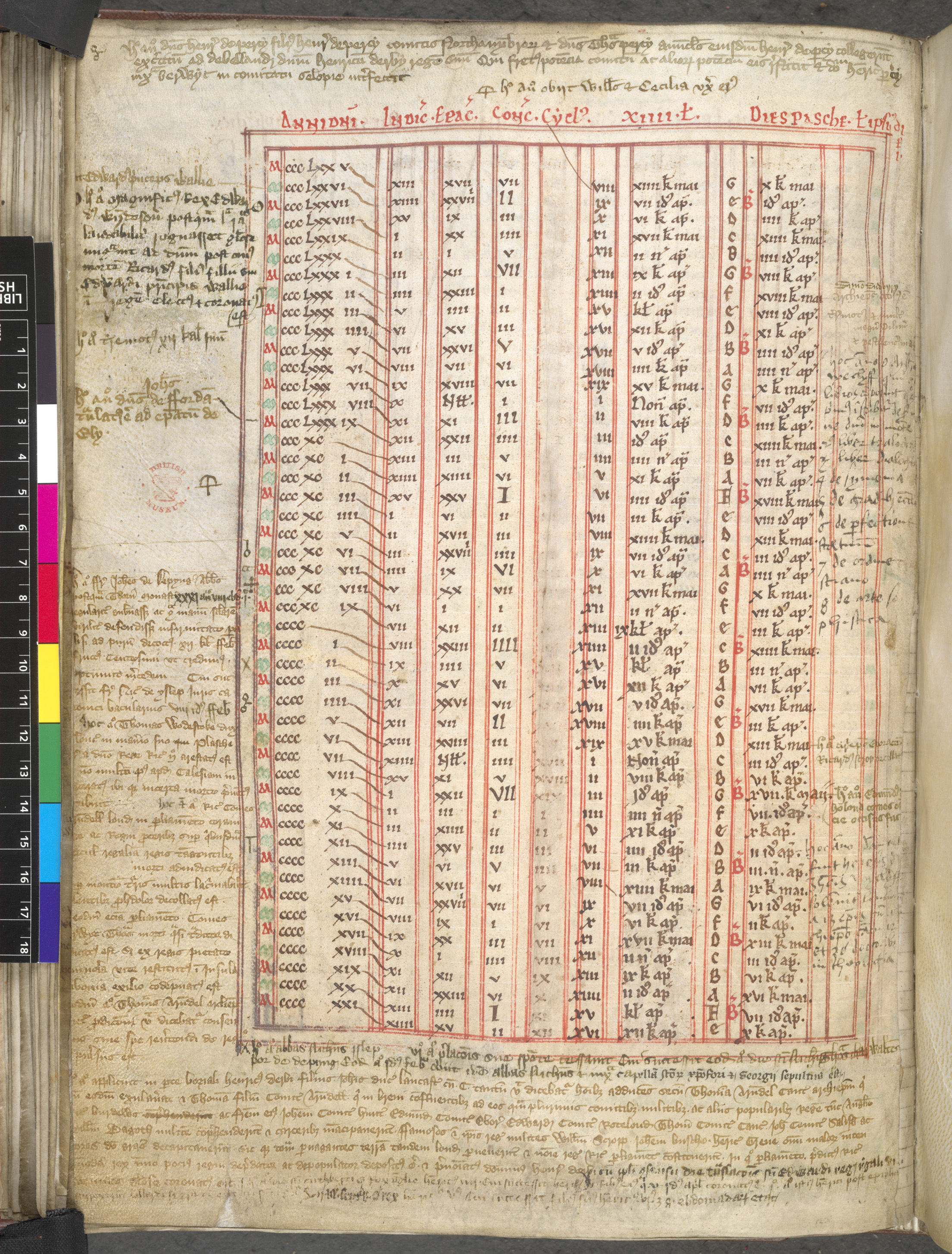
11. PASCHAL TABLES AND THEIR EXPLANATORY MATERIALS: fols. 135v-157r + British Library Cotton Nero C VII fols. 80r-84v. OVERVIEW
This section of MS 17 contains the following items:
- 1. Dionysius Exiguus, Two tracts on Paschal reckoning: fols. 135v-138v
- 2. Paschal tables: fols. 139r-155v + Cotton Nero C VII fols. 80r-84v.
- 3. Annals in margins of Paschal tables: fols. 139r-155v + Cotton Nero C VII fols. 80r-84v.
- *Transcription of annals
- 4. Dionysius Exiguus, Argumenta titulorum paschalium: fols. 156r-157r
11. PASCHAL TABLES: 2. PASCHAL TABLES
Location:fols. 139r-157r+Cotton Nero C VII fols. 80r-84v
Related Manuscripts:- Post-Conquest English computus manuscripts : "Peterborough Computus", Cambridge, St John's College A.22; Cambridge, St John's College I.15; Cambridge, University Library Kk.5.32; Durham, Dean and Chapter Library 100; London, British Library Cotton Caligula A.XV; Oxford, Bodleian Library Auct. F.3.14;
- Computus manuscripts in the Abbo of Fleury tradition : Berlin, Staatsbibliothek 138; Cambridge, Trinity College R.15.32; Paris, Bibliothèque nationale lat. 12117.
- Carolingian computus manuscripts : Munich CLM 210; Paris Bibliothèque nationale lat. 5543; Paris, Bibliothèque nationale nouv. acq. lat. 1615;
- Anglo-Saxon computus manuscripts : "St Dunstan's Classbook"; "Missal of Robert of Jumièges"; "Portiforium of St Wulfstan."
1. Paradigm Paschal table and "working" Paschal table
The Paschal tables, like the Argumenta titulorum paschalium which follow them on fols. 156r-157r, represent the dossier for which Dionysius Exiguus's Epistola ad Petronium (fols. 135va-137rb) was the cover letter. A Paschal table also appears as part of Computus Tables and Texts II on fol. 29r-v. In this latter case, the table serves a pedagogical purpose as a class-room paradigm; by contrast, the tables discussed here are "working" Paschal tables. This pairing of a short paradigm table (usually positioned with other tables used in Paschal computus), with a longer, functional Paschal table, is not unique to MS 17. MS 17's close cognate, the "Peterborough computus," contains a small table for the years AD 988-1006, in a setting very reminiscent of MS 17's paradigm table, but also longer contemporary tables (for AD 1069-1175) prefacing Dionysius' Epistola ad Bonifacium et Bonum. The paradigm table in Durham Hunter 100 also appears in the midst of computus tables, while the functional ones follow Dionysius' letters. In Cambridge, University Library Kk.5.32, a paradigm table appears on fols. 59r-v, while the annals are recorded in the "working" tables on fols. 61v-72v. Paris, BNF nouv. acq. lat. 1615 positions the paradigm table directly after the calendar, while the working tables precede De temporum ratione.
Both the paradigm table and the working version follow the same eight-column pattern established by Cyril of Alexandria and popularized in the west by Dionysius and Bede. It differed from Victorius of Aquitaine's table in two respects: it used annus domini instead of annus passionis to label the years, and it substituted indictions for Victorius' consular lists. 1 Consular reckoning was discarded as computistically non-functional, since it could only identify years in the past. Dionysius was only marginally interested in the link between computus and historiography, so he preferred indictions, which were actively used for dating administrative documents. The indiction could also be used as a sort of check-digit for verifying the annus domini, as Bede points out in ch. 48 of De temporum ratione.
The eight-column Paschal table might appear to be somewhat overburdened with information for the purposes it serves. All that is really essential is the annus domini and the date of Easter, and depending on the user's location, the indiction. The other columns are relics of the polemical context in which the table was created: the Easter terminus and the age of the moon on Easter day were flash-points of controversy in the Paschal debates of the Patristic age. But we might bear in mind that in a world with no annual calendars, being able to determine the weekday of a date in the future would require knowledge of the concurrent. Nonetheless, the elaboration of the Paschal table seems to have taken on an energy of its own: some tables actually expanded the eight-column format to ten or twelve columns, to accommodate the dates for the other moveable feasts. 2
2. The Great Paschal Cycle of 532 years
The stages by which MS 17's Paschal tables were written are discussed in the background essay "St John's 17: Materials and Structure." There it is argued that MS 17's compilers conceived of the tables in terms of Great Paschal Cycles of 532 years. Victorius of Aquitaine was the first to grasp that an Easter cycle constructed on Alexandrian lines would repeat after 532 years, but he did not understand why it would do so. Dionysius never remarked on the cycle, possibly because it was associated with Victorius, for whom he had little respect. Bede, however, understood why the table repeated (except for the indictions) after 532 years: 532 is the product of the 19 years of the lunar cycle, multiplied by the 28 years of the cycle of weekdays (7 weekdays x 4 leap years). This he explained in ch. 65 of De temporum ratione , where he also refers to his own successful construction of the cycle. 3 The theory of the 532-year cycle seems to have been well known in Bede's day. In his letter to Nechtan, king of the Picts, Bede's abbot Ceolfrith claims that there are many in Britain who can project such a cycle. 4
Bede's Great Paschal Cycle extended from AD 532 to 1063. To project tables backwards from 532 for historiographical purposes, or forward from 1063, medieval scribes adopted two solutions. One was to make a sequential table by copying a fresh 532 year table to go before or after Bede's table, with altered anni domini and indictions. Alternately, one could re-cycle the 532-1063 table by writing the new anni domini beside the old ones in the AD columns, because the computus data will be identical for any year occupying the same position within the cycle. For example, the tables in the Abbonian computus manuscript Berlin, Staatsbibliothek 138 fols. 46r-53r start at the left with three double columns of anni domini and indictions to accommodate three Great Cycles from 1 BC-AD 531, AD 532-1063 and AD 1064-1595. In Paris, BNF lat. 5543, the original table ran from AD 532 to 1063, but a later scribe started to transform it into a cyclical table by adding the years 1064-1082 to the AD column. The cyclical format was fairly common, 5 but even sequential tables reflected the underlying pattern of the Great Paschal Cycle. About one-third of the sequential tables examined by the author to date are formed of complete cycles. 6
1 Krusch 1938, 27 sqq.
2 This is the case with a number of English manuscripts broadly contemporary with MS 17: Oxford, Bodleian Library Auct. F.3.14 fols. 120r-132v (10-col. table with date of Pentecost and age of moon at Pentecost); Cambridge, University Library Kk.5.32 fols. 59r-v (10 cols. with dates of Septuagesima and Lent and year of 19-year cycle); "St Dunstan's Classbook" fol. 21r (11-col. table with aetas lunae initii, first day of Paschal lunation and weekday of 14 Nisan); "Missal of Robert of Jumièges" fols. 17v-18r (12-col. table with dates of Septuagesima and Lent, intervallum , and year of 19-year cycle ; "Portiforium of St Wulfstan." p. 22 (11 col. table with dates of Septuagesima and Lent, and intervallum); London, British Library Cotton Caligula A.XV fols. 132r-139r (9-col. table with aetas lunae initii).
3 Jones 1975-1980, 551-562 prints Bede's cycle for 532-1064. In Cambridge, St John's Coll. I.15, the tables, extended for a second cycle to AD 1595, are actually inserted into the text of De temporum ratione between ch. 65 and ch. 66.
4 Bede, Historia ecclesiastica 5.21 (546).
5 Cyclic tables are found in Oxford, Bodleian Library Auct. F.3.14 fols. 120r-132v; Cambridge, University Library Kk.5.32 fols. 61v-72v and Durham, Dean and Chapter Library 100 fols. 27v-41r. Manuscripts with annals inscribed in such cyclical tables used different coloured inks or signes de renvoi for each cycle.
6 E.g. Cambridge, St John's College A.22 (ends 1596); Cambridge, St John's College I.15 (1BC-AD1595); "Portiforium of St Wulfstan." (1064-1595); Paris, BNF lat. 5239 (532-1063); Paris, BNF nouv. acq. lat. 1615 (532-1063); Paris, BNF lat. 12117 (1 BC-AD 1063); Munich CLM 210 (1 BC-AD 1063) and Berlin, Staatsbibliothek 138 (1 BC-AD 1595).
11. PASCHAL TABLES: 3. ANNALS
Location:fols. 135v-157r+Cotton Nero C VII fols. 80r-84v.
Incipit:To see transcriptions of individual annals, move folio by folio through the Annals and use the Transcription drop-down menu on the navigation bar above
Related Manuscripts:- Post-Conquest English computus manuscripts : "Peterborough Computus"; Cambridge, St John's College A.22; Cambridge, St John's College I.15; Cambridge, University Library Kk.5.32; Durham, Dean and Chapter Library 100; Glasgow Hunter 85; London, British Library Cotton Caligula A.XV; Oxford, Bodleian Library Auct. F.3.14.
- Computus manuscripts in the Abbo of Fleury tradition : Berlin, Staatsbibliothek 138; Cambridge, Trinity College R.15.32; Paris, Bibliothèque nationale lat. 12117.
- Carolingian computus manuscripts : Munich CLM 210; Paris, Bibliothèque nationale lat. 5239; Paris Bibliothèque nationale lat. 5543; Paris, Bibliothèque nationale nouv. acq. lat. 1615
- Anglo-Saxon Computus Manuscripts: "St Dunstan's Classbook"; "Missal of Robert of Jumièges"; "Leofric Missal"; "Portiforium of St Wulfstan."
Identified, where possible in the full transcription of the annals.
- 1. Annals in Paschal tables
- 2. MS 17's annals: the Ramsey annals (538-ca. 1092)
- 3. MS 17's annals: the Thorney annals
-
3.1 Layers of annals
3.2 Signes de renvoi
3.3 Computus and the Thorney annals in MS 17
3.4 History writing at Thorney: the MS 17 annals and the Red Book of Thorney - 4. The transcription of the annals
1. Annals in Paschal tables
Both sequential and cyclic Paschal tables served as repositories for annals, and the reason for this particular intersection of computus and historiography has puzzled historians. Jones argued that it was a logical extension of the structure of the computus manuscript itself, and particularly the tension between the solar calendar and its martyrology (modular time, repeating without change, becomes the emblem of the eternity where the saints dwell) and the Paschal table with its annals (linear and unrepeatable time; mutability). 1 While Jones stopped short of crediting Bede or the Dionysian annus domini with the invention of Paschal table annals, others were less hesitant. Levison pointed to Bede's integration of computus and historiography in De temporum ratione as the foundation not only of the Historia ecclesiastica but of the whole tradition of Northumbrian history-writing. 2 Poole, on the other hand, traced it to the annus domini reckoning of Dionysius Exiguus, which liberated the historical narrative from the relative time-frame of regnal lists and set it against an objective and universal chronological backdrop. Recording events beside the AD column of the Paschal table was the primal act of scientific historiography, and it left annalistic traces on even the most discursive types of medieval history writing. 3 In Jones' words, medieval history writing was "forced into annalistic form by a required annual list." 4
Jones and Poole are, however, making rather different assertions: Jones, that the Paschal table's linear listing of discrete years made it an ideal location for recording events; Poole, that it was the particular way in which the years were distinguished, namely Dionysius' annus domini, that stimulated the creation of annals. But early medieval historiography, especially in Gaul, often unfolds without reference to any era, let alone one embodied in a Paschal table; moreover, non-Dionysian Paschal tables can also serve for annals, for example in Ireland. 5 Finally, the custom of appending notices of contemporary events to annual lists of rulers and functionaries can be traced to ancient Mesopotamia: it need not depend on a Paschal table, let alone one based on a particular era. 6
It is also possible to argue that it was the growth of interest in history and history-writing which stimulated the search for an objective chronological framework, and not the reverse. A Paschal table is oriented to future dates (namely, of Easters to come) and not to the past. That is why annals in Paschal tables tend, in the main, to be original and contemporary, rather than derivative and retrospective. In Plummer's phrase, the purpose of the Paschal table annal was "to characterize the receding series of years, each with a mark or sign of its own." 7 One is reminded of the fact that in ancient Egypt, it was the annals that produced the chronology, as years were named after the memorable events which occurred in them.
In addition, it should not be forgotten that the Christian world-chronicle, as developed by Eusebius and incorporated by Bede into ch. 66 of De temporum ratione, also uses a universal prospective era, normally the annus mundi. While such chronicles are arranged as notices labelled by year, they do not form a continuous list of years. Nonetheless, the two genres -- annals and chronicle -- are close in style and substance, and often difficult to distinguish, as the debates over Bede's use of Paschal table annals in his Historia attest. 8
Finally, manuscript evidence suggests that recording annals in Paschal tables was not a wide-spread or sustained activity, particularly in England. Apart from MS 17, Paschal table annals are confined to the Winchester annals of Ã_lsige (ca. 1023), 9 and to the following manuscripts: Durham Hunter 100, Glasgow Hunter 53, 10 British Library Cotton Caligula A.XV, 11 the annals in the "Peterborough Computus ," 12 the Malmesbury computus manuscript Bodleian Auct. F.3.14, 13 the "Leofric Missal," Cambridge, St. John's College A.22, 14 Cambridge University Library Kk.5.32 and Glasgow, Hunter 85. On the Continent, however, marginal annals in Paschal tables are more common: the example of Fleury is discussed below. The ambivalence towards Paschal table annals must in some degree be related to the fact that from a scribe's perspective, the eight-column Paschal table is not a particularly convenient medium for recording events. 15 In some manuscripts, the Paschal table is deliberately laid out with a wide margin to accommodate annals, e.g. in Cotton Caligula A.XV, 16 but MS17's tables do not contain this feature. The limitations imposed by the format also affected the content of the annals. Annals maintained outside the Paschal table framework could be composed in a coherent and deliberate manner: the preface of a 13th century Winchester chronicle recommends keeping notes of various events on scraps of parchment and writing them up at the end of the year. 17 By contrast, the annals in MS 17's Paschal table rarely deal with more than one event.
In defining the relationship between Paschal table and annals, the most helpful course seems to lie between the claims of Jones and Poole on the one hand, and those of their critics on the other. Paschal tables and AD reckoning probably did not "cause" annal-writing, but they were rarely far from the consciousness of medieval chroniclers. The close connection between computus and history manifested by Bede continued to resonate with his later imitators, such as the Worcester chroniclers of the 11th and 12th centuries. 18 Gervase of Canterbury's concern with a standard date for the beginning of the year lightly veils the powerful magnetic pull of computus and the Paschal table. Gervase justifies the choice of the Dionysian era, and of Christmas as the beginning of the year, by claiming that they permit him to correlate "the course of the solar year, the positions of the termini, the sequence of events and seasons, and particularly the decennovenal cycle," which "is the most vital factor in the enterprise." 19 By "decennovenal cycle," Gervase means the Paschal table. Were he to begin his year at the Annunciation, which was becoming fashionable in England, 20 he would be obliged to assign pre-Easter moveable feasts to one year, and those following Easter to the next. This would diminish the value of the Paschal table for determining the year when the source document is dated only with reference to a feast, e.g. "on the third Sunday in Lent." That Paschal tables were indeed used for this purpose is proven by examples of misdating in medieval chronicles and in MS 17's own annals.
2. MS 17's annals: the Ramsey annals (538-ca. 1092)
The annals in MS 17 fall into three groups: the Ramsey annals, the Thorney annals, and those composed in Oxford after MS 17 left Thorney. Most of the entries from 538 to 1092 were copied by Scribes A and B, and apparently in a single sweep, as the neat spacing and uniform script attest. It is almost certain that they derive from a source or sources assembled in nearby Ramsey abbey. Annals are definitely being composed at Thorney from 1085 onwards, but when the Ramsey annals gave out is not clear. Hart claims that they end in 1016, and that the post-1016 annals were retrospectively added at Thorney. 21 However, it should be noted that the annal for 1043 refers to the death of abbot Athelstan of Ramsey, the annal for 1080 alludes to the death of Aelfwine abbot of Ramsey, and the annal for 1092 mentions the election of Ealdwine as abbot of Ramsey.
The annals for the period 732-800 and 832-900 are particularly close to the Northumbrian Chronicle, i.e. the first section of the Historia regum ascribed to Symeon of Durham, one of the northern continuations of Bede's Historia ecclesiastica. In some cases, the Northumbrian Chronicle offers the only substantial parallel to MS 17's annals (e.g. 740, 749, 752...). 22 The Northumbrian Chronicle was composed by Byrhtferth of Ramsey, 23 but the Ramsey annals, at least as they appear in MS 17, betray little of his distinctive style. The two texts -- chronicle and annals -- probably drew on the same source materials. In 1970, Hart speculated that these materials were sent from York by archbishop Oswald, founder of Ramsey abbey, and that some of the York annals were entered into a Paschal table by none other than Abbo of Fleury during his sojourn at Ramsey. 24 In recent publications he has abandoned this hypothesis as his views on the role of the Anglo-Saxon Chronicle in the later Ramsey Annals have evolved. 25 Yet his initial hunch concerning Abbo's role has merit. The connection lies, not through the Anglo-Saxon Chronicle, but in the Continental practice, so rarely found in England, of writing marginal annals in Paschal tables. At least six computus manuscripts from Fleury and surrounding houses contain Paschal tables, and four of these include annals: Paris, BNF lat. 5543, lat. 5239, lat. 12117 and nouv. acq. lat. 1615. It is plausible that whoever composed the exemplar of MS 17's annals at Ramsey was following a Continental model: it may have been Abbo himself, or someone trained by him.
3. MS 17's annals: the Thorney annals
3.1 Layers of annals
The Thorney monks elected to continue to add annals to MS 17's Paschal tables; they also filled in some events in the abbey's history prior to the creation of the manuscript. The result is an exceptionally long sequence of annals from the foundation of the monastery in 973 to the accession of Henry VI in 1422. The complex early stages of this annalistic activity are described in the background essay "St John's 17: Materials and Structure."
Superficially, the Thorney annals give the impression of being composed at the time of the events recorded, but while this may be true in many instances, it is not uniformly the case. Much of the annal-writing in MS 17 is retrospective: this can be detected by the content or phrasing of the annal, or by the fact that the scribe also wrote annals for events which happened very much later. Scribe A's own annals for 1095-1109 could not possibly be contemporary, as the manuscript was probably not finished until 1111 (see fol. 3v dating clause): in the case on his annal for 1104, the reference to annual commemorative alms for the victims of the drowning accident gives the game away. Paleography also furnishes clues: the annal for 1188 is in the same hand which revised the 1208 annal, and is therefore unlikely to be contemporary. Another indicator of retrospective composition is the telescoping of annals for two or three years into a single entry (cf. 1118, 1207, 1228b, 1283). Finally, egregious mistakes in dating are certain evidence of retrospective writing. If, after every allowance has been made for variations in the beginning of the year, delays in the transmission of news, and vagaries in the mechanics of connecting the annal to the number of the year, we cannot avoid concluding that the date assigned to an event is wrong, then the annal is not contemporary.
3.2 Signes de renvoi
The problem of connecting annal to year is particularly acute in MS 17, with its narrow writing space and layers of additions. Signes de renvoi were one way of overcoming this. Signes de renvoi are also interesting in their own right, being small but eloquent clues to the strategies used by medieval scribes to connect information on the manuscript page. The frequency of signes de renvoi in MS 17's annals peaks in the 13th century. Only 25% of the 12th century annals have signes, while 35 of the 55 13th century entries are so equipped -- indeed, almost every annal after 1250 has one. The frequency drops to slightly less than 50% in the 14th century. There is also a formal change in the signes between the 12th and the 13th centuries. The earlier ones, like those in the glosses to MS 17's texts of De natura rerum and De temporum ratione , follow Carolingian convention by using Greek letters (e.g. nu in 1098; pi in 1100; mu in 1104; psi in 1109, 1120) as well as forms imitating Greek letters (cf. 1118). The more elaborate and fanciful 13th century signes reflect the contemporary development of complex and integrated systems of marginal signs for indexing purposes. Historians like Ralph Diceto and Matthew Paris favoured pictorial markers, such as a crown to flag events connected with the English king. 26 Scholastics like Grosseteste preferred a more abstract notation, for example a circle with a dot in the centre for "sight" or an L with a curl at the end of the horizontal shaft for "water." 27 MS 17's later signes may have derived from these practices, though they were not used for indexing, and do not represent any content.
3.3 Computus and the Thorney annals in MS 17
The influence of computus on MS 17's annalists is revealed by certain types of dating mistakes. Two examples will illustrate this. The annal for 1104, written by Scribe A, records the drowning of the monk Gualterius and five abbey servants on the feast of St Mathias. As mentioned above, this is evidently a retrospective annal. Above the feast day, Scribe A inserted further dating information, namely that the tragedy occurred at the time of Vespers on Friday (VI feria). But the weekday is wrong: it is a computistical reconstruction. 1104 was a leap year, so the feast of St Mathias, normally 24 February (6 kl. Mar.), would have been celebrated on 25 February because the "second 6th (kalends)" -- the bissextus -- followed the 7th kalends. 25 February 1104 fell on Saturday, not Friday. Hart suggests that because the accident occurred at Vespers, the feast of St Mathias would have officially begun (Hart 1997b, 48); be that as it may, the weekday would remain Friday until midnight. More likely, Scribe A forgot that 1104 was a leap year, and calculated the weekday of 24 February using computus tables and formulae like those on fol. 22r or 27v.
A similar case is presented by the annal for 1186 (recte 1185). The annalist dates the earthquake "after Palm Sunday" on 7 April, 1186, and states that it was Monday in Holy Week. This earthquake actually took place on Monday in Holy Week of 1185, which fell on 15 April. 28 The annalist's source evidently dated the event simply to Monday in Holy Week. The annalist mistook the year, and proceeded to carefully calculate a false date for the earthquake, perhaps by counting backwards from the date of Easter, which was right before his eyes in the Paschal table. An analogous situation occurs in the Annales Quedlinburgenses of ca. 1025. The annal for the year 1008 states that a star was seen in the middle of the day on the 6th ides of April (8 April) on the second feria (Monday) in Easter week. This was probably the nova of 1006. In 1006, 8 April was on Monday, but not in Easter week; in 1007, 8 April was in Easter week, but on Tuesday, not Monday; in 1008, 8 April is neither on Monday nor in Easter week. 29 The original source of the annal probably specified only the weekday and the calendar date. Somewhere along the line, the misleading information about Easter week was added, perhaps through confused reading of the computistical information for 1007 in the Paschal table.
The attraction exerted by the computistical data in the Paschal table for MS 17's annalists can be observed over a large sample of entries, thanks to Scribe A's mistake in omitting the year 1200 from the annus domini column (see background essay "St John's 17: Materials and Structure"). This meant that from 1200 onwards, the annus domini was one line above the relevant computistical data. The annalists sometimes chose to attach their material to the AD by writing next to the AD in the left margin of the table, or by flagging it with a signe de renvoi. On other occasions, they put the signe de renvoi against the Paschal information, or wrote in the right hand margin beginning on the line containing the correct Paschal information for that year, one line below the AD. It not infrequently happens, however, that they flagged the AD column, but actually intended to refer to the year corresponding to the Paschal information on that line. The annal for 1225 illustrates this phenomenon. The first annalist recorded the death of John, bishop of Ely, against the line containing the AD 1225 and the Paschal data for 1224. This annalist intended to refer to the AD. However, the second annalist who added that Fulk de Breauté left England "in the same year" thought that the first annalist was referring to the Paschal data, because Fulk left England in the autumn of 1224. In sum, the computistical setting of the annals was never far from the annalists' minds; offered the choice of recognizing the A.D. or the Paschal data as the distinguishing feature of the year, they often chose the Paschal data.
3.4 History writing at Thorney: the MS 17 annals and the Red Book of Thorney
The content of the Thorney annals is not of exceptional interest, as the entries are often very brief, and the coverage is uneven. Most entries record the accession of rulers in Church and state, and those topics of perennial concern to annalists, eclipses and the price of food. Entire decades of intense political and social activity in England pass without anyone at Thorney remarking on it on the leaves of MS 17; the reign of Stephen, for example, is quite bald, and there is no mention of the Peasants' Revolt of 1381. Space limitations appear to have inhibited some annalists from dilating even on events whose importance they appreciated. The 1258 annalist regrets that he can only allude to the baronial crisis of that year, "tot mirabilia...quod per se uolumen grande desiderant" ("such remarkable events...which in themselves need a big book"). Little is known about monastic communications networks or the circulation of news sheets, 30 but Thorney was well placed to gather news, being located close to important centres such as Peterborough, Ramsey, Ely and Bury St Edmund's. Moreover, the extensive and strongly Lancastrian account of the deposition of Richard II suggests that Thorney was one of the houses to which Henry IV sent an official account of his coup d'état for insertion into the chronicles. 31 The uneven quality of the Thorney annals seems to be due, not to a paucity of materials, but to fluctuating interest on the part of the monks, combined with the limitations of the annal format.
The monks of Thorney practiced history writing in other modes besides annals. A chronological summary from 1085 to 1470 prefaces the monastery's cartulary, the "Red Book of Thorney" (Cambridge University Library Add. 3020-3021). This summary takes the form of a table of four columns, correlating A.D. to the reigns of the kings of England, and the tenures of the abbots of Thorney and the bishops of Ely. It is written in a single hand to 1456, so the additional annals scattered throughout must have been copied after this date, though probably not long after. The dates of the abbatial and episcopal tenures sometimes differ from those of the MS 17 annals, and discrepancies of content confirm that the two documents are not using the same source. This can be appreciated by comparing the annal recounting the Black Death:
MS 17 (s.a. 1349): Hoc anno fuit per mundum uniuersum tanta mortalitas hominum quod uix aliquibus locis remansit quinta pars hominum. Eadem mortalitate moriebantur monachi thorneye <et> de familia CVIII
Red Book (fol. 8r, s.a. 1349): Magna mortalitas ita quod uix media pars populi remanebat. De monachis XIII moriebantur VIIem apud Depyng sepulti sunt. Et de familia abbatis centum moriebantur...
Despite some similarities of phrasing, the Red Book annal differs from that in MS 17 in its estimate of the percentage of the total population who perished, and in its breakdown of the dead at Thorney into monks and familia; moreover, it includes the figures for Thorney's cell, Deeping Priory. Either MS 17 or the Red Book confused "X" for "V", because MS 17 gives the total dead as "CVIII" while the Red Book says that one hundred died from the abbot's household, plus "XIII" monks.
Overall, the Red Book annals are less numerous than those in MS 17, but contain more information. For example, the Red Book notes that the great ecclesiastical council of 1215 took place at the Lateran, and furnishes a short biography of each abbot at his accession; for neither is there a parallel in MS 17. Abbot John of Deeping's troubles with the "seculars" are alluded to in somewhat general terms in MS 17 (s.a. 1396), but the Red Book spells out the issues over which he and his adversaries went to court.
The Red Book also contains annals for a number of events not noticed in MS 17, e.g. the elections and deaths of all the popes and archbishops of Canterbury, the general chapter of the Benedictines in Oxford in 1219, the coming of the Franciscans to England in 1225, and the Statute of Mortmain in 1278. MS 17's annals were plainly not the only repository of historical data at Thorney, which lends weight to the argument that Paschal table annals are not fundamentally historiographical in intent.
A parallel can be discerned between the calendar and martyrology on the one hand, and the Paschal table and annals on the other. In the discussion of the martyrology of MS 17, we noted that the martyrology developed as an independent literary form only when it detached itself from the calendar which engendered it. Removed from this matrix, it proceeded to reconstruct the calendar around itself by adding saints to fill in the hitherto unoccupied days of the year. Eventually these "literary" saints migrated back into the calendars, and thence into the liturgy. Annals follow a similar pattern. From being "characterizing" notices in some form of annual table, they break free into the more discursive paragraphed form. Gaps in the sequence of years are then filled in, and the annals become a chronicle. This chronicle can become a resource for further annal writing. In MS 17's annals we can see both the continuity of the "characterizing" tradition, and the effect of a sort of rebound from paragraphed annals, both in the longer notices (particularly at the beginning of the twelfth and the end of the fourteenth centuries) and also in retrospective annal writing.
4. The transcription of the annals
In the transcription of the annals prepared for this project, all abbreviations are expanded silently.
Up to the year 1200, the date of an annal is established by the annus domini line on which the annal begins, or to which a signe de renvoi is attached. After 1200, when the annus domini is one line above the remaining computistical data, dates are determined by the following criteria:
- 1. A date given without comment indicates that the signe de renvoi is against the annus domini for the year indicated, or against the computistical data for that year. If there is no signe de renvoi, but the annal begins either on the line for the correct annus domini or the correct computistical data, the annalist is given the benefit of the doubt and the annal assigned to the correct date.
- 2. If the signe de renvoi is against a certain annus domini, but the event occurred in the year corresponding to the computistical data on that same line, the annalist is again given the benefit of the doubt, but the situation is explained in the commentary.
With few exceptions, the commentaries are not concerned with the historical content of the annals. Rather, their purpose is:
- 1. to discuss discrepancies of dating;
- 2. to indicate "telescoped" or retrospective annals, as well as the role of astronomical and computistical data in the process of annal-writing, as discussed above;
- 3. to provide, on occasion, some historical commentary, particularly for annals relating to local history.
1 Jones 1947, esp. 5-15.
2 Wilhelm Levison, "Bede as Historian," in Bede: His Life, Times and Writings 112-114. In defence of this view, it should be noted that the prologue of the Lindisfarne life of Cuthbert quotes two types of sources: computistical (Victorius of Aquitaine's letter to archdeacon Hilarius) and hagiographical (vitae of Anthony, Martin and Silvester): Colgrave 1940, 60-62.
3 Poole 1926, 25-26.
4 Jones 1943, 116.
5 Gaul: Harrison 1975, 47 sqq. The Chronograph of 354 includes two sets of annals, a world-chronicle, and a chronicle of Rome, but they are not connected with the manuscript's Easter table: see Mommsen's ed. in Chronica minora saec.IV, V, VI, VII (1), MGH AA 9 (1892):1-196. Ireland: ?CróinÃn 1983a, Harrison 1977-1978. An annal for AD 501 is recorded in a Victorian Paschal table in a 7th c. Burgundian MS described by Krusch 1884a.
6 Newton 1972, 48-52.
7 Two of the Saxon Chronicles Parallel 2.xix.
8 Bede's dating errors are attributed to his failure to use Paschal table annals by Kirby 1963, 514-515; for evidence of his use of an annalistic chronicle of Northumbrian affairs from 685-721, see Blair 1948.
9 ed. Birch 1892, 279.
10 ed. G.H. Pertz, Annales aevi Suevici , MGH SS 19, 502-508.
11 ed. P. Baker in Anglo-Saxon Chronicle F, appendix.
12 ed. Liebermann 1879, 13-14.
13 ed. Stevenson 1907, 81-82.
14 ed. Previt-Orton 1922.
15 Gransden 1974, 30 and n. 9-10; Newton 1972, 45; Jones 1943, 114-117.
16 Cf. reproduction in Garmondsway 1953, xxiv-xxv.
17 This advice prefaces the Worcester chronicle printed by H. R. Luard in Annales monastici, RS 36 (1864-1867), 4.355, but it is copied from a Winchester source: Gransden 1974, 319, n.7.
18 Gransden 1974, 114.
19 "Sic enim anni solaris cursum, ordinem quoque terminorum seriemque rerum et temporum, et maxime ciclum decennovenalem, valebo comprehendere, quem prae ceteris ciclis huic negotio necessarium esse existimo:" Gervase of Canterbury 1.90.
20 The trend from Christmas to Annunciation apparently became general around the mid-13th c. It is announced in the Dunstable annals s.a. 1243 and in the Winchester-Hyde chronicle s.a. 1261: Cheney 1969, 97; Denholm-Young 1934, 88-89. On the earlier prevalence of Christmas, see Poole 1921, 43-44.
21 Hart 1997a, 86.
22 Hart 1970, 37; Hart 1997a, 71.
23 Lapidge 1982; Hart 1982.
24 Hart 1970, 32, 38.
25 Hart 1997a, 72-73. Hart argues for a Ramsey origin for the Annals of St Neot's (Hart 1981), as well as for some of the early material in the Worcester Chronicle (Hart 1983a).
26 Ralph Diceto: Gransden 1974, 234-235 and pl. VII. Matthew Paris: Gransden 1974, 364 and pl. IX.
28 Newton 1972, 724.
29 Ed. Pertz, in Annales, chronica et historae aevi Saxonici, MGH SS 3 (1839); cf. Newton 1972, 107.
30 Gransden 1974, 143, 318-319; Orderic Vitalis, Ecclesiastical History 1.85.
31 Gransden 1982, 186-188.
Annals: Transcription and Notes
Year: 1376
Location: Cotton Nero C. VII, fol. 84v
Transcription: < Obi> it Edwardus princeps Wallie.
Annals: Transcription and Notes
Year: 1377
Location: Cotton Nero C. VII, fol. 84v
Transcription:
hoc anno magnificus rex Edwar-
dus de Wyndesor postquam LaI annis
laudabiliter pugnasset gloriose
migrauit ad dominum post cuius
mortem Richardus filius fil[l]ii sui
Edwardi principis Wallie
in regem electus et coronatus est.
Annals: Transcription and Notes
Year: 1381
Location: Cotton Nero C. VII, fol. 84v
Transcription: Simon Sudbury archiepiscopus occisus est.
Commentary: "Simon Sudbury" is in another hand. Simon Sudbury was bishop of London 1362-1375 and archbishop of Canterbury 1375-1381. He was killed in the Peasants' Revolt: Hart 1997a, 55.
Annals: Transcription and Notes
Year: 1382
Location: Cotton Nero C. VII, fol. 84v
Transcription: terremotus et multa magna diluuia et pestilencia magna.
Commentary: Cf. annal for 1384.
Annals: Transcription and Notes
Year: 1384 (recte 1382)
Location: Cotton Nero C. VII, fol. 84v
Transcription: Hoc anno terremotus XII kalendas iunii.
Commentary: This annal is in the outer margin next to the A.D. Duplicates information in annal for 1382.
Annals: Transcription and Notes
Year: 1385
Location: Cotton Nero C. VII, fol. 84v
Transcription:
Hoc anno obiit Iohannes
Wyclyff qui multos
libros composuit quorum
primus inscribitur de sermo-
ne domini in monte.
2us liber tr <i> alogus.
3 liber dialogus.
4 de symonia
5 de gradibus ecclesie
6 de perfectione
statuum
7 de ordine <chri> stiano
8 de arte so-
phistica.
Commentary: This annal is in the inner magin, beginning of the list for the Paschal data. Written by the hand of the 1255(b), 1411 and 1519 annals. Possibly Robert Talbot, although his highly distinctive "g" is notably absent in "gradibus", and the uncial "d" is not characteristic of his hand. Not all the works of Wycliffe which he mentions are easy to identify: no. 4 may be De potestate papae, no. 5 De ecclesia, and no. 8 De logica.
Annals: Transcription and Notes
Year: 1388
Location: Cotton Nero C. VII, fol. 84v
Transcription:
Hoc anno dominus \Iohannes/ de Fordam
translatus est ad episcopatum de
Ely.
Commentary:This annal begins on the A.D. line for the correct year, 1388; a later hand has drawn a line from the annal to 1389. Written in the 14th /15th c. hand which also wrote the annals for 1373. John Fordham was translated from Durham to Ely in 1388 and died in 1425: Hart 1997b, 55; Red Book of Thorney fol. 8v.
Annals: Transcription and Notes
Year: 1392
Location: Cotton Nero C. VII, fol. 84v
Transcription: hoc anno obiit Willelmus et Cecilia uxor eius
Annals: Transcription and Notes
Year: 1396
Location: Cotton Nero C. VII, fol. 84v
Transcription:
Hoc anno frater Iohannes de Depyng abbas
postquam Thornensem monasterium XXXI annis VIII edbomadis
constanter gubernasset ac contra manum secularem
uiriliter defendisset infirmitate para
lisi ad purum decoctus XII kalendas Februarii
fructus centesimi ut credimus.
optinuit mercedem. Cui suc-
cessit frater Nicolas de yslep iuris ca-
nonici bacularius VIIIidus Februarii.
Commentary: This annal is in the same hand as the 1397 and 1399 annals, and possibly in that of the scribe which inserted numerous post-mid-14th century documents in the Red Book of Thorney.John of Deeping's quarrels over the church at Yakesley, the tithes of St Guthlac's at Deeping, and with the men of Wisbech are noted in Red Book of Thorney fol. 8r. "XXXI annis VIII edbomadis" is written over an erasure in another hand. Nicholas of Islip's academic qualifications and his resignation is also noted in Red Book of Thorney fol. 8v; see annal for 1402 below.
Annals: Transcription and Notes
Year: 1397
Location: Cotton Nero C. VII, fol. 84v
Transcription:
Hoc anno Thomas Wodestoke dux
lancastrie in manerio suo qui Plasshe
uocatur a domino Rege Richardo IIo arestatus est <.>
non multum post apud Calesiam in
[ *** < car > ] ceratus ibique in certa morte preuentus [ *** ]
buit <.> hoc etiam anno Richardus comes
Arundell londoniis in parliamento coram
[ *** < re > ] ge et Regni proceribus super quibusdam
articulis regalia regis tangentibus
morti adiudicatus est
[ *** < su > ] per montem turris multis lacrimabiliter
[ *** < do? > ] lantibus proh dolor decollatus est.
Eodem etiam parliamento. Comes
[ *** < wa > ] rwyk Thomas morti quasi traditor di
[ *** < iud > ] icatus est sed ex Regis pietate
[ *** < ben > ] iuola uite restitutus in Insula
[ *** ] ibonibus exilio condempnatus est
[ *** < e > ] odem anno Thomas Arundel archiepiscopus
[ *** ] er proditioni ut dicebatur consen-
[ *** < tie > ] ns sine spe reuertendi de regno
expulsus est.
Commentary: Hart 1997b, 40 splits this annal into two at the trial of Richard of Arundel, and dates the second half to 1398. However, he omits the word "etiam" at the beginning of this section ("Hoc etiam anno...), and there is no indication that the scribe intended any break here. Thomas was Duke of Gloucester, not Lancaster. Thomas of Warwick was exiled to Man. In the same hand as the 1396 and 1399 annals; this scribe is contemporary and perhaps identical with the scribe who inserted numerous post-mid-14th century documents in the Red Book of Thorney .
Annals: Transcription and Notes
Year: 1399
Location: Cotton Nero C. VII, fol. 84v
Transcription:
<H> oc anno applicuit in parte boreali henricus derbi filius Iohannis ducis lancastrie cum C tantum ut dicebatur hominibus adducens secum Thomam Arundel cantuariensem archiepiscopum qui
anno eodem exulauerat et Thomam filium Comitis Arundell qui in breui confluentibus ad eos quamplurimis comitibus. militibus. ac aliis popularibus Regem tunc Anglie
Richardum burdews ("comprehenderunt", cancelled) ac fratrem eius Iohannem Comitem Huntingdon. Edmundum Comitem Eboracensis. Edwardum Comitem RotelondThomam Comitem Cantie. Iohannem Comitem Salisberie ac
Willelmum Bagott militem comprehenderunt et cerceribus mancipauerunt. Famosos in ipsis regis milites Willelmum ScoppIohannem busche. Henricum Grene omnium malorum inten
[ *** < tato > ] res deo gratia decapitauerunt. sicque totam peruagantes terram tandem londinium peruenerunt et nomine regis Ricardi parliamentum constituerunt. In quo parliamento. predictus Ricardus
quondam ex immo pocius regni depredator ac depopulator depositus est. et prenominatus dominus henricus derbi cum populi consensu die translationis sancti edwardi regis regali
diademate gloriose coronatus est. Eodem anno in festo sancti cuthberti obiit rex anglie henricus IIII. Cui successit henricus filius qui V idus aprilis coronatus est. Io anno istius henrici post epiphaniam
[ *** ] 2o anno. II kalendas septembris obiit rex henricus Vus. Cui successit filius eius henricus VIus 38 ebdomadarum etatis.
Commentary: In same hand as 1396 and 1397 annals (perhaps that of a scribe which inserted numerous post-mid-14th century documents in the Red Book of Thorney ), save for "cui...2o anno" which is added in another hand, and evidently after Henry V's death in 1422. As the second hand actually completes a sentence from the passage begun by the first scribe, it is not impossible that the entire annal was composed after this date. Notice that it breaks off at the beginning of an account of the second year of the reign of Henry V. The last year on this page is 1421, 1422 having been erased by the scribe Gothic I, who began his own series of Paschal tables with this year (see background essay "St John's 17: Scribes and Scripts").
Annals: Transcription and Notes
Year: 1402
Location: Cotton Nero C. VII, fol. 84v
Transcription:
Hoc anno abbas Nicholas de islep VIo anno prelacionis sue sponte cessauit. Cui successit eodem anno die sancti Nicholai Thomas Charwalton
prior de depyng. Eodem anno idibus februarii obiit idem abbas Nicholas et iuxta capellam sanctorum christofori et Georgii sepultus est.
Commentary: "capellam...sepultus est" added in another hand. Thomas Charwalton was abbot of Thorney 1402-1425. Red Book of Thorney fol. 8v notes that he was elected "post reginationem Nicholai Islep...per uiam compromisse."
Annals: Transcription and Notes
Year: 1404 (recte1403)
Location: Cotton Nero C. VII, fol. 84v
Transcription:
Hoc anno dominus henricus de percy filius henrici de percy comitis Northamymbrorum et dominus Thomas percy auunclus eiusdem henrici de percy collegerunt
excercitum ad debellandum dominum henrycum derby regem suum Qui fretus potentia comitum ac aliorum potencium eis restitit et dominum henricum percy
iuxta berwyc in comitatu salopie interfecit.
Commentary: Signe de renvoi is against A.D. 1404, but the Paschal data on that line refer to the correct year, 1403. The battle of Shrewsbury is also recorded in Red Book of Thorney fol. 8v.
Annals: Transcription and Notes
Year: 1405
Location: Cotton Nero C. VII, fol. 84v
Transcription:
Hoc anno archiepiscopus Eboracensis
Richardus scrop decollatus <est> .
Commentary: Line connects this annal to Paschal data for this year. Richard le Scrope was bishop of Lichfield 1386-1398 and archbishop of York 1398-1405. Hart 1997b, 55 notes that he was a kinsman of both the Percy family (cf. annal for 1404) and of Thomas Gascoigne, who not long afterwards apparently acquired MS 17 (see background essay "St John's 17: The Fortunes of the Manuscript").
Annals: Transcription and Notes
Year: 1408
Location: Cotton Nero C. VII, fol. 84v
Transcription: Hoc anno Edmundus de Holland comes cantie occisus fuit.
Annals: Transcription and Notes
Year: 1411
Location: Cotton Nero C. VII, fol. 84v
Transcription:
Hoc anno damnatus
fuit heresis
Iohannis Wyclif
solemniter Londoniis
a 13 episcopis cum ar-
chiepiscopo cantuariensi
et 30 doctoribus in theologia.
Commentary:Written by the same hand as annals for 1255 (b), 1384 and 1519. Possibly Robert Talbot, although his highly distinctive "g" is notably absent in "theologia", and the uncial "d" is not characteristic of his hand.
