
Contents: The Lachine Canal and Montreal’s Industrial Heritage | Industrial and Working-Class Neighbourhoods | Living Conditions in Industrial Neighborhoods
The Lachine Canal and Montreal’s Industrial Heritage

The building of the Lachine Canal, a waterway connecting the Great Lakes with the Atlantic Ocean, was a significant event in the history of Montreal. The Canal literally changed the appearance and texture of the city, attracting industrial interests and both immigrants and the rural population of Quebec. The idea of constructing a canal originated in the earliest days of New France. The St. Lawrence River was the main artery of communication and transportation and in 1689, Francois Dollier de Casson, the Superior of the Sulpicians, who at the time owned the island of Montreal, planned and financed a canal which was to be two kilometres long. However, work on the canal ceased after only two months due to the discovery of a large body of rock in the path of construction and a surprise attack made by the Iroquois. Dollier de Casson made a second attempt in 1700 but upon his death a year later, work was again abandoned (From Sicotte, 4).
With the conquest of New France by the British and the enlargement of trade from the previous era, where canoe transportation was adequate for the movement of fur, the idea of building of a canal was resurrected. The transportation of timber and wheat, as well as military concerns, made the need for a reliable route around the Lachine rapids more acute. In 1781, the first operational canal was built between Lac Saint-Louis and Lac Saint-François. The growth of trade with Upper Canada and the construction of the Erie Canal in the United States soon demanded a faster route. In 1821, construction of the Lachine Canal commenced. The project was financed jointly by the governments of Lower Canada and England and some 500 Irish immigrants provided the bulk of the labour force (From Sicotte, 4). The canal was finished in 1825. As the demand for the transportation of goods increased and with the introduction of larger ships, the Lachine Canal was upgraded and enlarged in the period between 1843 – 1848 and again between 1873 and 1885.
It was this period of construction and modification of the Lachine Canal which was to have a dramatic effect on the city of Montreal. The canal not only increased shipping, making Montreal one of the largest ports in North America, but also attracted industrialists who were interested in locating along the canal. The canal and the later completion of the Grand Trunk Railway line in 1871, provided the opportunity for city authorities to actively encourage warehouse and factory construction. The banks of the canal made prime locations for factories in need of water—either to provide power to drive their machines and for use in their production process. The government rented industrial lots along the canal and allowed factories to take a certain quantity of water directly from the canal through regulated intakes. The first industries to locate along the canal were flour mills, nail manufacturers, foundries and sawmills and by 1850 the canal was the site of the heaviest concentration of industry in Canada; employing a population of workers estimated to be around two thousand in 1856 (From Sicotte, 16).
As with other North American cities, the presence of newly introduced factories had affected the development and texture of everyday life. Factory owners were attracted to the city for its pool of both unskilled and skilled labour and, at the same time, attracted a large population of immigrants and workers from rural areas of the province. Areas such as Griffintown and Points-Saint-Charles in the Ste-Anne Ward, as well as the municipalities of Saint-Henry and Sainte-Cunegonde, were transformed into industrial and working-class neighborhoods. While providing work opportunities, the presence of factories in Montreal brought with them many social problems characteristic of the period. Child labour, poor working conditions, long work hours, unsanitary living conditions and high mortality rates were just some of the problems faced by residents of these neighborhoods causing Sir Herbert Brown Ames in 1897 to call Montrealers to pay attention to these growing problems: “… Montreal should, for a time, cease discussing the slums of London, the beggars of Paris and the tenement house evils of New York and endeavor to learn something about themselves and to understand more perfectly the conditions present in their very midst” (Ames, 7). This is why we decided that a website about industrial architecture in Montreal should also reflect the conditions of the working class, and so we have provided a section on the living conditions of these working-class neighborhoods.
The industrial boom lasted well into our own century until changes in industrial production caused many of the factories to relocate to larger and more modern facilities and other forms of transportation made business less reliant upon water and rail. The legacy of Montreal’s early industrial period can still be seen today and many of the original factories and warehouses are being converted for residential and other commercial uses or have or are slated for demolition. The purpose of this website, then, is to document many of the industrial sites along the Lachine Canal and other areas of Montreal; preserving this civic heritage through visual and textual documentation as the city of Montreal enters the new millennium.
Industrial and Working-Class Neighbourhoods
The industrial and economic expansion in the nineteenth century brought unparalleled prosperity to cities such as Montreal. Under the surface, however, these same industrial and economic forces brought with them a variety of new social problems for urban populations. Saint-Henri, Griffintown and Pointe-Saint-Charles, like other industrial/residential neighborhoods, suffered from many of these urban problems. Poor working conditions and wages, poor housing and living conditions, and child labour were just some of the realities faced by the inhabitants of these areas within Montreal.
By the latter half of the nineteenth century, health and living conditions became an ever greater concern for some of the city’s leading citizens. Sir Herbert Brown Ames (1863-1954), one of Montreal’s business and administrative leaders, was one of the few prominent city officials to voice his concern over urban living conditions for the city’s poor. In a series of articles delivered as lectures or published in the Montreal Star, Ames urged his fellow citizens to pay attention to the effects of industrialization on the city’s working class. In 1897, Ames stated:
“… Montreal should, for a time, cease discussing the slums of London, the beggars of Paris and the tenement house evils of New York and endeavor to learn something about themselves and to understand more perfectly the conditions present in their very midst” (Ames, 7).
It is often difficult to imagine the living conditions for past residents of these neighborhoods. However, it is possible to piece together what these conditions must have been like as some of the original housing remains and is still used by current inhabitants of Montreal. We have provided, therefore, information on three industrial neighborhoods in Montreal–Saint-Henri, Griffintown, and Pointe-Saint-Charles–and a section on living conditions of these neighborhoods.
Saint-Henri
During the period around 1850, a series of settlements—Turcot, Brodie, Saint-Agustin and Sainte-Marguerite—surrounding the village of Saint-Henri began to form. These various workers’ villages merged in 1875 to form the municipality of Saint-Henri which, by 1881, had a population of 6,400 (Sicotte, 39). By the turn of the century, the surge in industrial activity in Montreal also had an important effect on Saint-Henri. Companies such as Imperial Tobacco, Stelco, RCA Victor and Johnson Wire Works built facilities in the neighborhood. Much of the area’s existing housing was built at this time to accommodate working-class families who were attracted by the new industrial activity. By 1905, Saint-Henri had 21,192 inhabitants (Sicotte, 40). That same year, financial hardship on the part of the municipality forced its annexation by the city of Montreal. By the late 1940s, however, southwestern Montreal was the largest industrial centre in Canada and Saint-Henri formed its most important neighborhood. This period of activity lasted until the 1960s when some companies, in need of larger and more modern industrial facilities, began to leave the area.
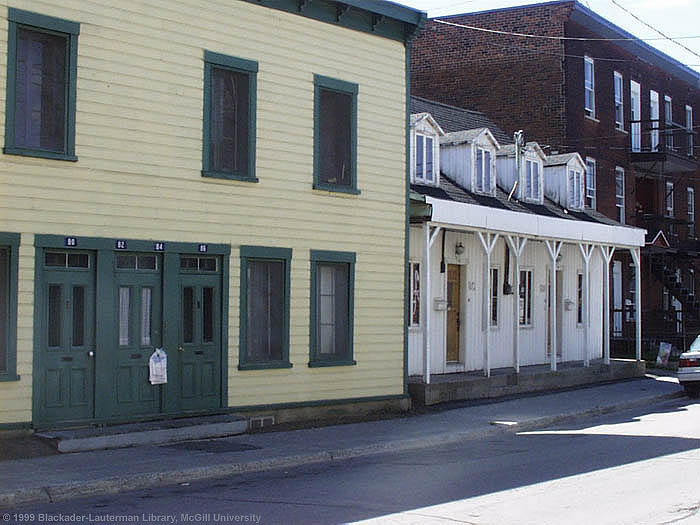
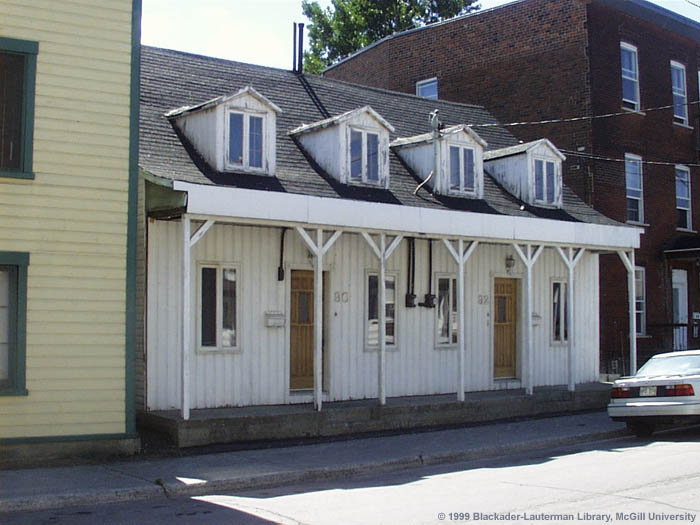
Today, Saint-Henri’s industrial legacy is still visible. Companies such as Imperial Tobacco and Johnson Wire still operate in the neighborhood and long-abandoned factories have been converted for other uses. As well, examples of workers’ housing still remains.
Griffintown
The area known as Griffintown was once a working-class neighbourhood stretching as far north as Notre-Dame street and bounded on the east by McGill street and on the west by Guy. Originally, this area was known as the Nazareth fief and made up the east half of a larger fief ceded to Jeanne Mance in 1654 and administered by the nuns of Hôtel-Dieu. In 1791, Thomas McCord signed a 99-year lease of the fief from the Hôtel-Dieu nuns (Sicotte, 20). At the time, there was already talk of building the Lachine Canal; a prospect which could make this parcel of agricultural land very valuable for future subdivision. In 1796, while McCord was in England, his business associate fraudulently sold the lease to Mary Griffin. Griffin planned a subdivision where lots would be rented and the revenue to be shared by herself and the nuns (Recollets, 30).
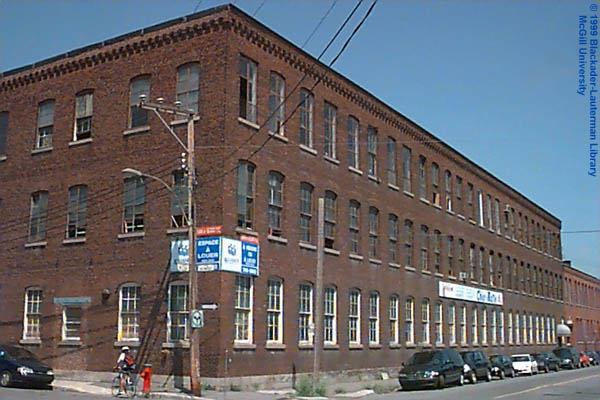
In 1923 there were no more than a hundred houses in the area, most of which were located east of Nazareth Street. However, the building of the Lachine Canal (the first seven locks were completed in 1825) attracted many working-class families to Griffintown. In 1853, after the enlargement of the Canal (1843-48), the area of Griffintown was described as being entirely built up. By the turn of the century, the neighborhood was home to 30,000 inhabitants (Sicotte, 20,21).
Griffintown was populated by recently-arrived immigrants who were recruited by the area’s many industrial businesses who wanted cheap, unskilled labour. The famines and land clearances in Ireland between the years 1845-47, forced two million Irish to emigrate. Many of these Irish immigrants came to Montreal and would form the majority of Griffintown’s population.
Griffintown was often mentioned for its over-crowding and cramped living conditions. In his study from 1897, Ames pointed out the discrepancy in living conditions between wealthy areas of the city (‘the upper city’) and the areas inhabited by the working-class (‘the city below the hill’):
“The sanitary accommodation of ‘the city below the hill’ is a disgrace to any nineteenth century city on this or any other continent. I presume there is hardly a house in all the upper city without modern plumbing, and yet in the lower city not less than half the homes have indoor water-closet privileges. In ‘Griffintown’ only one home in four is suitably equipped, beyond the canal [in Pointe-Saint-Charles] it is but little better. Our city by-law prohibits the erection of further out-door closets, but it contains no provision for eradicating those already in use. With sewers in almost every street, no excuse for permitting this state of affairs to continue now exists, except it lies in neglect and in greed” (Ames, 105).
Pointe-Saint-Charles
At the beginning of the 18th Century this area was owned by the Sulpicians who maintained large market gardens in the area. By the end of the 19th Century, the countryside had changed radically. Two churches, St-Gabriel and St-Charles, were built between 1891 and 1899 (corner of rue d’Ilse and Centre). The factories around Saint-Gabriel Locks and the Grand Trunk Railway shops in the southwestern part of the Pointe, had attracted workers to the area between the canal and the river as many wanted to live in proximity to their places of work. The neighborhood was inhabited primarily by Irish, Scots and English (Sicotte, 32).
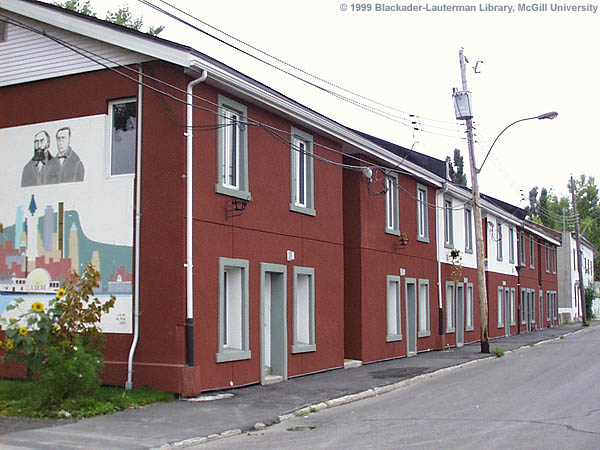
An interesting example of worker’s housing from that period is a row of houses which still exists today on Sebastopol Street. This row of small white housing, which has recently been refurbished, was among the first terraced houses in Montreal built on the model of industrial cities in England. The development of this section of the neighborhood, which is one of the oldest, was influenced by the Grand Trunk Railway. In 1854, the company was employing some 2000 workers. Some of the skilled workers were recruited directly from England and it was for them that Grand Trunk built such housing (Sicotte, 35). These were typical of working class housing of the period lending a distinctiveness to the city’s streets that remains today. At the time, this type of housing was constructed in terraces, the fronts set flush with the street line, and having only enough space in the rear to hold privies, the community well, and the wash house (Bradbury, 1993, 72).
Sebastopol Row, as it was called, was built by the railway construction firm of Peto, Brassy & Betts in 1857, on a length of land next to the shops of the Grand Trunk Railway. The housing project consisted of a long row of duplexes, or more specifically, terraced flats, that was built as permanent workers’ housing. It was named “Sebastopol Row” to commemorate the 1855 fall of Sebastopol to French and British troops during the Crimean War and was one of the largest housing projects of its time in Montreal (Hanna, 69). What made Sebastopol Row distinct was the introduction of grouping four flats in one building where each pair of upstairs flats shared an exterior doorway and interior staircase; this would be typical for the design of later Montreal housing. As seen in the photographs taken in the fall of 1999, Sebastopol Row has been renovated with its original appearance and history kept in mind, as murals depicting the history of the housing project have been integrated into the front facade and side elevation.
Living Conditions in Industrial Neighborhoods
In the 1800s Montreal registered higher mortality rates than any other British North American city. Poor and unsanitary housing was identified by doctors and health officials as the root cause of the high rates of illness and mortality. Rapid settlement and population growth, poor construction, and profiteering contributed to these poor living conditions. In the 1850s, a doctor named Philip Carpenter argued that City Council should take more responsibility for the poor state of Montreal housing:
“It is the duty of this council to see that wages of death are no longer wrung from the hard won earnings of the poor, but that all who undertake to let homes shall be compelled to put them and their surroundings into a condition favourable to health” (Bradbury, 1993, 73).
Despite the appointment of a health officer in the 1870s and the creation of a Health Department in the 1880s, citizens of Montreal retained “their unenviable distinction as the dwellers in the city of wealth and death” throughout the nineteenth century (Bradbury, 1993, 73). When the Royal Commission on the Relations of Labour and Capital examined Montreal in 1888, its descriptions of working-class housing focused on the worst cases, the “nests of contagion,” the “rows of houses, rickety, propped up facing dirty sheds and germ-breeding closets,” and domestic settings where illness “reigned supreme” (Bradbury, 1993, 74). Working and living conditions were often difficult for those living in Montreal:
“The typical Montreal family of 1897 was made up of a husband, wife and three children who lived in a five-room, cold water flat located on a narrow, densely populated side street in what is now the inner core of the city. The husband, who hoped to be able to work sixty hours a week, fifty-two weeks a year, was more likely to find himself faced with ‘short time’ if not a layoff, especially during the winter months. Even if regular work was available, the average wage earner could not provide his family with more than a bare subsistence” (Copp, 29).
One in every five adult workers was a woman and women predominately worked in textile mills, tobacco factories, food processing, retail and domestic service. Her wages, substantially lower than those of men, often made the difference between bare subsistence and modest ‘prosperity.’ Large numbers of children were involved in part-time work even though official statistics vastly underestimated the extent of paid child labour and did not account for the unpaid labour of hundreds of young girls who worked as full-time babysitters (Copp, 29).
In most working-class neighborhoods, there were no facilities for bathing and toilets consisted of community privy pits in the backyards. A journalist named Arthur Short described a rear yard on Ottawa Street in Sainte-Anne Ward where eight families were paying $4 per month in the lower apartments and slightly more in those above. In front of the houses, in the yard, were twelve outhouses, serving both these occupants and the families on the cross-street, McCord. Some fifteen cases of diptheria had recently spread among these families (Bradbury, 1993, 74). Shortly after the Commission’s visit, the city began a “vigorous campaign” against privy pits and encouraged the use of waterclosets. When Herbert Ames examined parts of Sainte-Anne Ward a few years later, 70-80% of the dwellings in the southern part of the ward around the Lachine Canal and more that half the homes in the entire area still relied on “that relic of rural conditions, that insanitary abomination, the out-of-door-pit-in-the-ground privy” (Ames, 45). For his part, Ames maintained a campaign against the pit privy in Montreal for eight years, earning the title, “Water Closet Ames” (Copp, 15).
Other than the Montreal Street Railway Co., the carter’s wagon and the horse and carriage were the only means of transportation (Copp, 17). In 1899 there were 3,000 horse stables and 500 cow stable within city limits. The Municipal Board of Health recommended that the cow stables, at least, be banned within city’s boundaries (Copp, 17). In 1898, only twenty-seven of the one hundred and seventy-eight miles of streets were paved and both dust and mud were constant problems. Elzéar Pelletier, Secretary of the Provincial Board of Health, complained that the streets “were in an intolerable state though tolerated” and that the lanes were constantly used as “refuse dumps” (Copp, 18).
The city-owned water supply was generally available but was of poor quality. It was unfiltered and untreated and while it was described, in the 1897 Annual Report of the Superintendent of the Montreal Water Works, as being “pure during ordinary times,” the supply of water became “dangerous during spring and fall” (Copp, 18).
In the study published by Herbert Ames, the average family income was $11 per week. The range of incomes was over $20 for the top 15 1/3 percentile (the “well-to-do”) and under $5 per week for the bottom 11% (“the submerged tenth”). These figures were based on some combination of earnings from more than one wage earner and the estimate that average weekly wages of $8.25 for a man, $4.50 for a woman, and $3.00 for a boy were “not too wide off the mark” (Copp, 21). Steady work, however, was a constant concern for the working-class of Montreal as many experienced temporary layoffs or reduced hours during some period of the year.
The average family lived in a flat of five rooms and the average rental costs worked out to $8.75 per month (18% of monthly income). Griffintown was an exception where 45% of the population had three rooms or less to share among a family of five. Overall, housing was not overcrowded by contemporary standards and rent as a percentage of income was not out of the ordinary (Copp, 25). Montreal’s mortality rate, however, had been steadily declining but, in the 1890s, it was still among the highest in the civilized world.
Infant mortality, was yet another problem as Montreal was one of the most dangerous cities in the civilized world in which to be born. Between 1899-1901, 26.76% of all newborn children died before they were one year old. This was largely the result of unsafe water, impure milk, and limited use of vaccination against smallpox and diphtheria.
Ames encouraged business and industrial leaders in the city to furnish Montreal workers with better and more sanitary accommodations. Ames, for his part, believed that this could be done while still providing entrepreneurs with the “hope of a fair return upon capital thus invested” (Ames, 112). In 1895, Ames purchased land upon the south-east side of William street (between Ann and Shannon Streets) in the heart of Griffintown. Upon this land, Ames built “four blocks of buildings, containing homes of varying size and rental, for 39 families, with a grocery store upon the corner where no liquor is sold” (Ames, 112-3). This model housing complex was called Diamond Court and was designed to provide safe and sanitary living conditions combined with spaces providing privacy and areas to be used in common. Families in the same complex would share a single front door, gas-lit vestibule, and inside stairways to their respective apartments. Other innovations included solid brick construction, concrete kitchen floors with central drains, a furnished stove, sink, washtub and water closet. A janitor, whose services were given in lieu of rent, also resided on the premises.
Almost a century later, Ames’ experiment in social housing would succumb to some of the same forces which Ames himself fought against at the end of the nineteenth century. Ironically, this limited-dividend model of social housing was eventually torn down in the 1970s as ‘slum housing.’