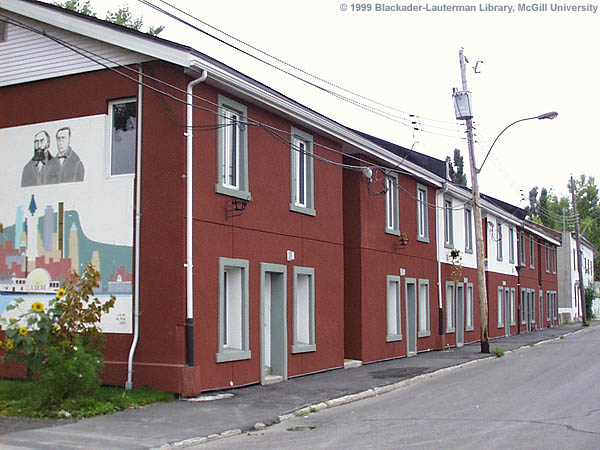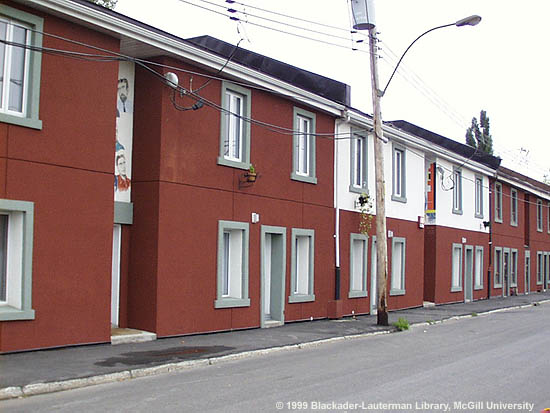
| Pointe-Saint-Charles | At the beginning of the 18th Century this area was owned by the Sulpicians who maintained large market gardens in the area. By the end of the 19th Century, the countryside had changed radically. Two churches, St-Gabriel and St-Charles, were built between 1891 and 1899 (corner of rue d’Ilse and Centre). The factories around Saint-Gabriel Locks and the Grand Trunk Railway shops in the southwestern part of the Pointe, had attracted workers to the area between the canal and the river as many wanted to live in proximity to their places of work. The neighborhood was inhabited primarily by Irish, Scots and English (From Steam, 32). An interesting example of worker’s housing from that period is a row of houses which still exists today on Sebastopol Street. This row of small white housing, which has recently been refurbished, was among the first terraced houses in Montreal built on the model of industrial cities in England. The development of this section of the neighborhood, which is one of the oldest, was influenced by the Grand Trunk Railway. In 1854, the company was employing some 2000 workers. Some of the skilled workers were recruited directly from England and it was for them that Grand Trunk built such housing (From Steam, 35). These were typical of working class housing of the period lending a distinctiveness to the city’s streets that remains today. At the time, this type of housing was constructed in terraces, the fronts set flush with the street line, and having only enough space in the rear to hold privies, the community well, and the wash house. (Bradbury, 1993, 72)
Saint-Henri
| Griffintown | Pointe-Saint-Charles | Living Conditions | Sources |